
People rarely distrust the idea of a performance review. They distrust the process: ratings that appear from nowhere, goals that changed halfway through the year, or a final score that reflects the last six weeks. Trust is built by the process, and most of it happens long before the review meeting.
This post covers the practices that make reviews feel fair, and how they map onto H2R Performance.
Start with clarity, not forms
A review can only be as fair as the expectations behind it. If an employee cannot say what good looks like for their role this quarter, no template will rescue the conversation.
- Set a small number of goals per person, usually three to five.
- Write each one so a stranger could tell whether it was met. “Improve customer service” is a wish; “reduce open tickets older than five days to under ten” is a goal.
- Agree the goals with the employee, not for them.
- Revisit them when priorities change, and record the change. A goal that silently changed is the most common source of “that is not what I was told”.
See goals and check-ins for how goals are tracked in the product.
Check in regularly
The review should summarize conversations that already happened, not introduce new information. A short, regular check-in (every two to four weeks is a common rhythm) does three jobs:
- It keeps goal progress visible and honest.
- It gives the manager a running record to draw on, which is the best defense against recency bias.
- It catches problems when they are still small.
A check-in does not need to be long. Three questions are enough: what moved, what is blocked, what do you need from me?
Collect more than one viewpoint
A single manager’s view is useful but incomplete. A 360 approach adds:
- Self-review. The employee describes their own results first. Gaps between self and manager views are where the real conversation is.
- Manager review. The accountable assessment, grounded in goals and check-ins.
- Peer input. Colleagues who actually work with the person, not just friends. Choose three or four, and tell people how their answers will be used.
Some rules that protect trust: ask about specific behaviours and examples rather than personality; make it clear whether comments are attributed; and never use a single peer comment as the basis for a rating. Our help article on 360 feedback and coaching notes explains how this is set up.
Keep private coaching separate from shared feedback
Not every piece of feedback belongs in the formal record. Day-to-day coaching (“next time, send the agenda before the meeting”) is most useful when it is quick, kind and private. Formal feedback that will feed a review should be written knowing it may be read later.
H2R keeps these apart: private coaching is readable only by the person who sent it and the person who received it, and shared feedback is a different action. The practical rule is simple. Before writing, ask yourself whether this is meant to help the person improve quietly, or to be part of the evidence for their review. Then use the matching option, and do not mix them.
Note: Do not use private coaching to build a hidden case against someone. If an issue is serious enough to affect a rating, it should be raised openly and recorded.
What calibration is
Different managers rate differently. One treats “meets expectations” as the top of the scale; another hands out the highest rating freely. Without correction, an employee’s rating depends partly on who their manager is.
Calibration is a structured meeting, run by HR or a senior leader, where managers compare draft ratings against the same criteria and examples. The goal is consistency, not a forced curve.
How to run it fairly
- Prepare the evidence. Each manager brings goal results, check-in notes and feedback summaries for every person rated.
- Agree the criteria first. Define what each rating level means with a sentence and an example.
- Review outliers and boundaries. Start with the highest, the lowest and anyone close to a boundary.
- Ask for evidence, not adjectives. “Strong” is not evidence; “led the migration and finished two weeks early” is.
- Check for patterns. Are part-timers, remote staff or one department rated consistently lower? If so, ask why.
- Record the reason for every change. Adjustments without a reason are what people later call unfair.
- Keep it confidential. Only the outcome goes back to the employee, delivered by their manager with the reasoning.
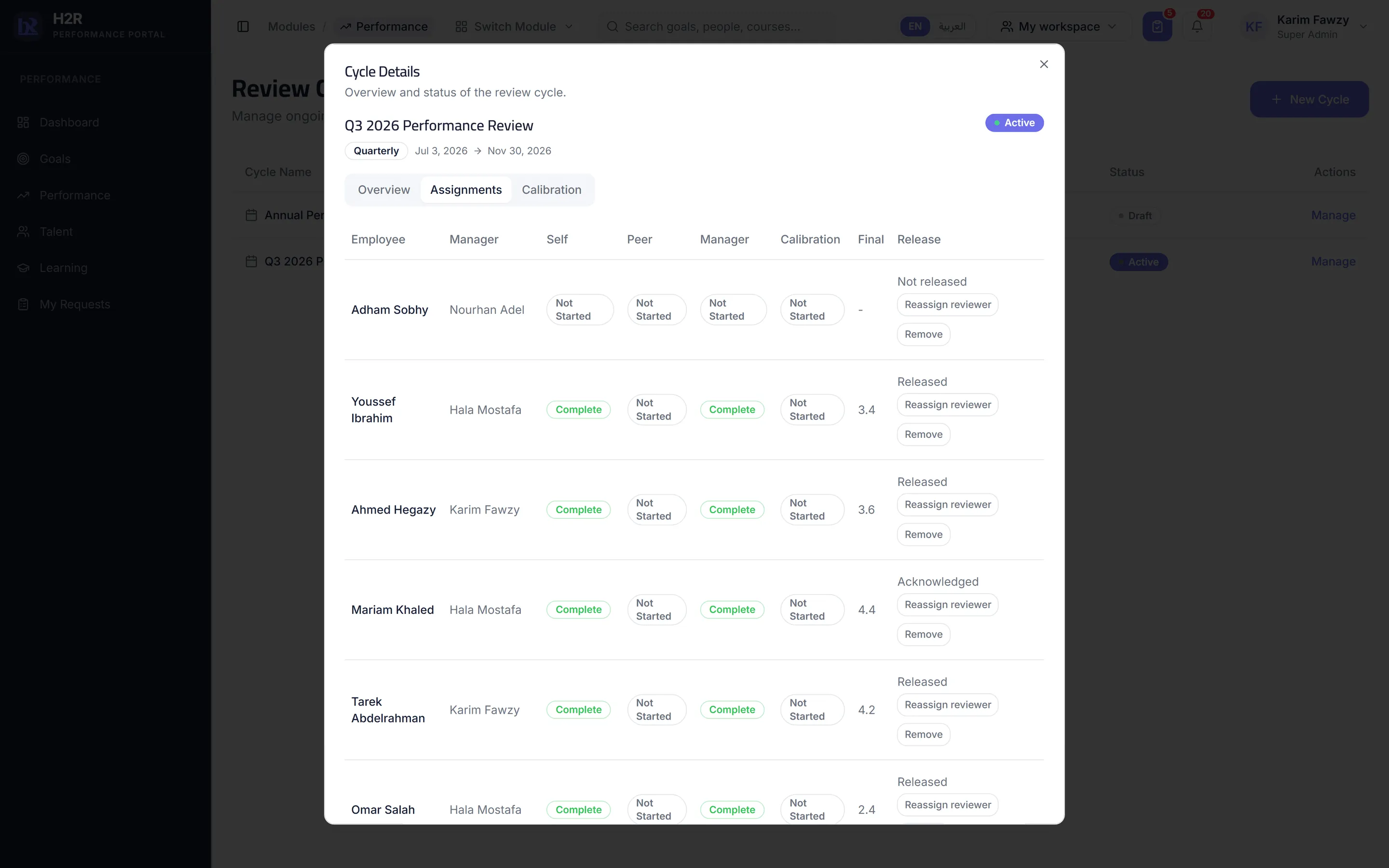
H2R includes a calibration stage in the review cycle so these adjustments happen in one place. The setup is covered in review cycles.
Use the 9-box grid carefully
The 9-box grid places people on two axes, usually performance and potential, to support talent and succession conversations. It is useful and easy to misuse.
- Treat it as a discussion aid, not a verdict. A box is a starting point for a conversation.
- Potential is a judgement about the future and is more subjective than performance. Bring evidence for it too.
- Do not show employees a box without context and a development plan.
- Re-assess regularly; people move.
- Keep placement separate from pay decisions unless your process says otherwise and people know it.
The nine-box grid article shows how it is used in the product.
Avoiding recency bias
Recency bias is the tendency to rate on the last few weeks. Counter it with habits:
- Keep dated notes through the year, ideally in check-ins.
- Before writing a review, read the whole year’s record first.
- Write the strongest and weakest example from each quarter.
- Ask whether the same behaviour in month two would have changed the rating. If so, you are weighting the wrong thing.
Common mistakes
- Surprises. If a review contains a concern that has never been mentioned, the process failed earlier.
- Too many goals. Ten goals means none are real.
- Skipping the self-review. It signals that the employee’s view is not wanted.
- Treating calibration as a quota. Fixing consistency is different from forcing a distribution.
- Letting reviews decide everything. A rating is one input, not the whole story.
To set up your first cycle, follow the guide to create your first review cycle.
Questions people ask
What is calibration in a performance review?
Calibration is a meeting where managers compare their draft ratings against shared criteria so that similar work gets similar ratings across teams. It adjusts for strict and lenient managers; it is not a way to force a distribution.
Should coaching notes be visible to the employee?
It depends on the intent. In H2R, private coaching is readable only by the sender and the recipient, while shared feedback is part of the wider record. Decide which one you mean before you write it.
Is the 9-box grid a rating?
No. It is a conversation tool for talent and succession discussions. Use it with evidence and avoid showing employees a box without context.